NopCommerce vs Magento – An eCommerce Platform Comparison
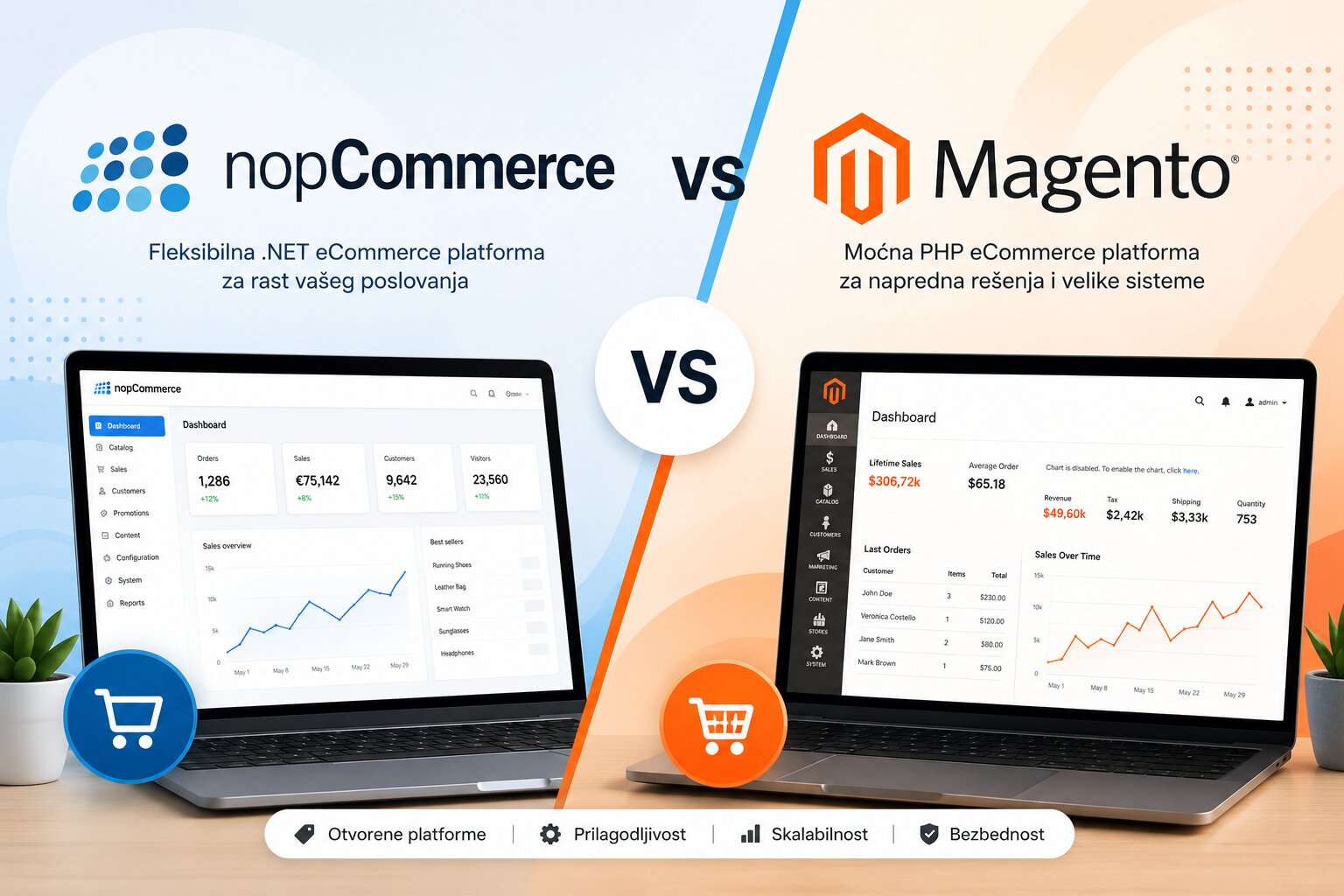
When choosing a platform for an online store, a name such as Magento will almost always appear on the shortlist. Given its track record, it is one of the most widely used enterprise eCommerce platforms worldwide. However, another, less familiar name is increasingly being considered, particularly by companies that already operate within the Microsoft ecosystem or require advanced functionality without licensing costs: nopCommerce.
At first glance, the two platforms offer similar benefits: publicly available source code, extensive customisation options, and a free core version. Beneath the surface, however, they are built on entirely different technologies, follow different development philosophies and, ultimately, are best suited to different types of businesses.
In summary, nopCommerce is a free, source-available platform built on Microsoft .NET technologies, including C#, ASP.NET Core and MS SQL Server. It is known for its relatively straightforward administration and extensive B2B functionality included in the core version. Magento, now officially known as Adobe Commerce, is a PHP-based platform with a much larger market share, an extensive ecosystem of extensions and broader customisation capabilities. However, it also comes with a steeper learning curve and, as a rule, higher development costs.
For a team that already works within a .NET environment and is looking for a lower total cost of ownership, nopCommerce is a strong option. For larger catalogues, more complex B2B workflows and access to the broadest possible developer market, Magento remains an industry standard.
In this article, we take a detailed look at the technology, costs, security, ecosystem and specific business scenarios in which each platform makes sense, supported by data from official sources such as W3Techs, BuiltWith and the nopCommerce documentation.
What Is nopCommerce?
nopCommerce is an open-source – or, more precisely, source-available – eCommerce platform founded by Andrei Mazulnitsyn and officially launched in October 2008. Unlike Magento, which is written in PHP, nopCommerce was built on Microsoft technologies from the outset. Today, it uses the ASP.NET Core framework, the C# programming language and an MS SQL Server database.
Several key facts about the platform include:
- The current stable version is nopCommerce 4.90.4, released in March 2026, while the platform core was migrated to .NET 9 with version 4.80.
- Version 4.90, released in October 2025, introduced a significant package of enterprise features, including a more advanced B2B module, AI tools for content generation and SEO, and more granular access controls within the administration panel.
- The platform is distributed under its own nopCommerce Public License. Its source code is publicly available on GitHub and free for commercial use, but it is technically distributed under a source-available licence rather than an OSI-approved open-source licence, as is the case with Magento Open Source.
- It can run on Windows, Linux and macOS servers following the transition to .NET Core. In practice, however, most hosting environments and tutorials still rely on Windows and IIS, primarily because of the MS SQL Server database.
According to W3Techs, nopCommerce currently powers fewer than 0.1% of websites whose content management system is known, representing approximately 0.2% of all eCommerce systems monitored by the company. BuiltWith currently identifies around 8,900 active nopCommerce websites, in addition to several tens of thousands of websites that have used the platform in the past.
Interestingly, there are also dozens of confirmed examples in Serbia, including the well-known local website Uradi-sam.rs.
What Is Magento (Adobe Commerce)?
Magento was launched in 2008 as a PHP-based eCommerce platform. It later became part of eBay and was acquired by Adobe in 2018, after which it was renamed Adobe Commerce.
Today, the platform is available in two main product editions:
- Magento Open Source – The free edition, distributed under the OSI-approved OSL 3.0 licence and offering fully open-source code.
- Adobe Commerce – The commercial, paid edition, which includes additional enterprise functionality such as advanced B2B modules, AI-powered personalisation tools, cloud infrastructure and SLA-backed support.
We previously covered the differences between the older and newer generations of the platform in detail in the article Magento 1 vs Magento 2 – Key Differences and Benefits. It is worth noting that support for Magento 1 ended in June 2020. As a result, any current decision involving a new Magento project effectively means choosing Magento 2 or Adobe Commerce.
According to the latest official W3Techs data from July 2026, Adobe Commerce currently powers 0.3% of all websites on the internet, 0.4% of websites with a known CMS, and 1.5% of all eCommerce systems tracked by the company. Compared with nopCommerce, this makes Magento several times more widely used.
Technical Architecture – .NET vs PHP
This is the most fundamental difference between the two platforms and the one from which almost every other difference arises, from hosting costs to developer availability.
| Feature | nopCommerce | Magento (Adobe Commerce) |
|---|---|---|
| Programming language | C# | PHP |
| Framework | ASP.NET Core | Proprietary Magento framework |
| Database | MS SQL Server | MySQL / MariaDB |
| Recommended server | Windows / IIS, with Linux and Docker also supported | Linux / Apache or Nginx |
| Core edition licence | nopCommerce Public License – free, source-available | OSL 3.0 – free, OSI-approved open source |
| Search engine | Built-in search / Lucene | Elasticsearch / OpenSearch |
The practical implication is straightforward. If your internal or external development team already works with .NET and C#, nopCommerce will fit naturally into your existing technology stack.
If your team comes from a PHP background – which is statistically more likely, given that PHP still has a significantly larger global developer base – Magento will require less technological adjustment.
Scalability and Performance
Both platforms can support substantial traffic volumes, but they reach that level in different ways.
Magento is designed for large and complex product catalogues, ranging from thousands to millions of SKUs. To maintain reasonable performance at that scale, it relies on a combination of Elasticsearch or OpenSearch for product search, Varnish or Full Page Cache for caching, and Redis for session management.
This architecture is powerful, but it requires more advanced server infrastructure and a team capable of configuring and maintaining it correctly.
nopCommerce can handle catalogues of up to approximately 50,000 SKUs without extensive optimisation. Above that level, more effort is required to optimise the database and infrastructure, much like with Magento.
The platform also supports load balancing and web farm configurations natively, making it a viable option for larger projects as well.
Security, Updates and Support
Both platforms are actively maintained, which is essential. Earlier versions of both products, such as Magento 1, now represent a genuine security risk precisely because they no longer receive official patches.
- nopCommerce follows a regular release cycle, including version 4.80 in December 2024, version 4.90 in October 2025, and version 4.90.4 in March 2026. Its patches are aligned with the broader .NET security cycle.
- Magento and Adobe Commerce also follow a scheduled security patch programme, supported by an active Adobe Security team that monitors and responds to reported vulnerabilities.
- As with any self-hosted platform, PCI DSS compliance and server security remain the responsibility of the store owner or the agency maintaining the website. The platform alone cannot guarantee security if the infrastructure is not configured and updated correctly.
For a broader overview of essential digital security practices for businesses, see our article How to Protect Your Business from Hackers – Essential Security Measures.
Ecosystem, Extensions and Developers
This is where the difference in platform adoption becomes particularly noticeable.
- Magento has a substantially larger marketplace, with some estimates placing the number of extensions on the official Adobe Commerce Marketplace at more than 5,000. It also benefits from a vast independent community across GitHub, Stack Overflow and specialised forums.
- nopCommerce has a smaller but active marketplace containing several hundred plugins and themes, supported by a dedicated community on its official forum.
- Because PHP is significantly more widespread than C# and .NET within the eCommerce development community, finding experienced Magento developers is generally easier than finding a highly capable nopCommerce team.
B2B, Multi-Store and Multi-Vendor Capabilities
This is one area in which nopCommerce performs surprisingly well relative to the size of its ecosystem.
The free version of nopCommerce includes:
- Full support for B2B, B2B2C and B2C business models within the same installation.
- Multi-store functionality, allowing multiple stores to share the same database, product catalogue and customer accounts.
- A multi-vendor marketplace module supporting an unlimited number of sellers.
- Contract pricing, quick-order lists and access controls based on customer groups.
Magento Open Source provides a strong foundation for multi-store operations, with somewhat more granular control over themes, currencies and languages for individual storefronts than nopCommerce.
However, advanced B2B functionality – including company accounts, approval workflows and advanced price lists – is reserved for the paid Adobe Commerce edition and is not included in Magento Open Source.
SEO Capabilities
Both platforms provide a solid set of essential SEO features, including customisable URLs, meta tags and XML sitemaps.
Magento offers somewhat more mature and comprehensive SEO controls. These include built-in support for structured data through Schema.org, hreflang tags for multilingual stores and, through PWA Studio, the ability to create fast, mobile-first stores that can perform well against Core Web Vitals metrics.
Since version 4.90, nopCommerce has also included AI-powered SEO tools directly within the administration panel. These tools can accelerate the creation of meta descriptions and the optimisation of website content.
However, the depth of its advanced functionality, particularly in relation to structured data and international SEO, still falls behind the Magento ecosystem. Magento benefits from a much larger selection of specialised SEO extensions developed over nearly two decades.
nopCommerce vs Magento – Comparison Table
| Criterion | nopCommerce | Magento (Adobe Commerce) |
|---|---|---|
| Technology | C# / ASP.NET Core / MS SQL | PHP / MySQL |
| Market share according to W3Techs | Fewer than 0.1% of websites with a known CMS | 0.4% of websites with a known CMS |
| Cost of the core edition | Free | Free with Magento Open Source |
| B2B features in the core edition | Yes, extensive | Limited, with full functionality available in the paid edition |
| Learning curve | More gradual, with a more intuitive administration panel | Steeper and generally requires more experience |
| Extension marketplace | Several hundred extensions | Several thousand extensions |
| Developer availability | Lower, due to the specialised .NET ecosystem | Higher, as PHP is more widely used |
| Recommended catalogue size | Up to approximately 50,000 SKUs without extensive optimisation | Millions of SKUs with Elasticsearch or OpenSearch |
| Typical user profile | SMBs and mid-sized B2B or B2C companies, particularly those operating within a Microsoft environment | Mid-sized and large enterprises, complex B2B businesses and organisations with large catalogues |
Which Platform Should You Choose for Your Business?
The following questions can help you make the right decision:
- Does your team, or the agency you work with, already have experience with a particular technology stack?
If the answer is .NET and C#, nopCommerce can reduce the time required for technical adaptation. If the answer is PHP, the same logic applies to Magento. - How large is your catalogue, and how quickly is it growing?
Both platforms perform well with tens of thousands of SKUs. For millions of products and extremely high traffic volumes, the Magento ecosystem – including Elasticsearch, Varnish and Redis – has a longer and more established track record at that scale. - How important is immediate B2B functionality without additional licensing costs?
If you require contract pricing, multi-vendor functionality or company account features from the first day, and your budget is limited, nopCommerce includes many capabilities for free that would require an Adobe Commerce licence within the Magento ecosystem. - How important are community size and long-term developer availability?
Magento remains the clear leader in this area, particularly in the regional market. - Are you planning global enterprise expansion supported by advanced marketing and AI integrations?
Adobe Commerce, combined with Adobe Experience Cloud, offers a level of integration that nopCommerce does not currently provide to the same extent.
Frequently Asked Questions
Is nopCommerce Completely Free for Commercial Use?
Yes. The core community edition is free to download, install, and use commercially.
Costs arise from hosting, custom development, themes and any paid marketplace extensions you decide to use, rather than from the core platform licence itself.
Can nopCommerce run on Linux Hosting?
Technically, yes. Since the transition to .NET Core, the platform has been cross-platform and can operate on Windows, Linux and macOS.
In practice, because of its use of MS SQL Server and the established preferences of its community, most installations are still deployed within Windows and IIS environments or through Docker-based systems.
Which Platform Requires Less Technical Knowledge for Everyday Use?
nopCommerce has a reputation for offering a more intuitive administration panel and a gentler learning curve for content editors and store managers.
Magento offers a broader range of options, but it generally requires more time to learn, particularly for users without a technical background.
Can I Migrate from Magento to nopCommerce or Vice Versa?
Yes, but such a migration should be treated as a new development project rather than a straightforward data transfer.
The architectures are fundamentally different – PHP and MySQL on one side, and C# and MS SQL Server on the other. As a result, migration typically requires a completely new front end, new extension integrations and comprehensive testing, much like a migration from Magento 1 to Magento 2.
Which Platform Is Better for B2B Sales?
When the budget is limited, nopCommerce offers a surprisingly extensive range of B2B functionality in its free edition, including multi-vendor capabilities, contract pricing and company accounts.
Magento also provides excellent B2B support, but the more advanced layers of that functionality are available through the paid Adobe Commerce edition.
Why Does Magento Have a Much Larger Market Share Than nopCommerce?
The primary reason is that PHP has been a dominant web-development language for decades. This has created a much larger ecosystem of developers, agencies, and extensions around Magento.
This does not necessarily mean that nopCommerce is an inferior platform. It means that the market niche in which it developed is smaller and is primarily connected to Microsoft-based environments.
Conclusion
Neither nopCommerce nor Magento is universally better. Each platform is optimised for a different type of business.
nopCommerce makes sense when your team’s technology stack is centred on .NET, when you require B2B functionality immediately without additional licensing costs, and when reducing the total cost of ownership is a priority.
Magento, or Adobe Commerce, makes sense when you are building for long-term enterprise scale, when you require the broadest possible selection of extensions and developers, and when you plan to integrate your store with the wider Adobe marketing ecosystem.
At RedWood Digital, we have been developing online stores for more than 15 years, and Magento, now Adobe Commerce, is one of our core areas of expertise – from smaller product catalogues to complex B2B architectures.
If you are considering the development of a Magento store or are unsure whether Magento is genuinely the right platform for your specific requirements, we would be happy to review your needs, catalogue size and budget with you and recommend the approach that makes the most sense for your business.
The final solution may be Magento or another platform we work with, such as Shopify, WooCommerce or BigCommerce.